Here is a series of articles I wrote nearly 4 years ago commenting on the ICC Test championship and its associated schedule (to be read in sequence).
The "ideal" Test championship
The ICC's system - a rating or a Championship
Building a Perfect World Championship schedule
Analysis - ICC Vs PWC
Accommodating One Day Internationals
The reason I have put the link here? Because I heard that the BCCI finally want to play 12 Tests and 30 ODIs every year, that too with Major countries and don't care a hoot about the ICC Test Championship.
Can't blame India. Frankly, does anybody really care about the Championship which (as I pointed out 4 years ago) was a badly implemented idea (Like most things we have come to expect from the ICC).
I admit the "perfect" schedule I have proposed in these articles is far from perfect, but I came up with it one weekend on a excel spreadsheet. And didn't make millions of dollars for doing it either :-)
Enjoy...
Tuesday, January 17, 2006


Monday, January 16, 2006
The Lahore Pitch...
While I am in the middle of an analysis highlighting the virtues of Test cricket (over ODI’s), this (pitch) seems like a conspiracy against my blog.
Anyway, I am sure there is still hope that something can be done to put some life into the Lahore pitch like…
- Placing a dummy in the middle of a Rugby stadium in UK and informing the Americans that Bin Laden has been spotted playing ball in Europe. And wait for them to land a few cluster bombs with pin point accuracy (one must add) at the Gadaffi Stadium in Lahore, causing just about enough damage for Kaneria to turn the ball. And to minimize collateral damage, just make sure only the curator of the ground is present near the pitch. …and Ganguly.
- Getting experts like the Shiv Saniks who can alter the conditions of the pitch overnight.
- Asking all right-handed Indian batsmen to bat left handed and vice versa, and hope they get out quickly. Except Ganguly. Why bother...
- Selling the rights of the Lahore pitch for $10 million to Nike, so they can swoosh it with their logo. That might just do it.
- Blow up a cylinder in the stands and wait for Afridi to do his little "twist & turn" routine. Again to minimize loss of life in the stands....
- Allowing the Pakistani bowlers to bend their arms by 30 degrees so they can extract some life out of this pitch. On second thoughts, it wont make any difference to either Akhtar or Malik.
- Allowing a special Super-sub rule for the last day of the Test, so that Pakistan can sub 10 of the Indian batsmen…with Ganguly. And make sure he bats left-handed...
Any more suggestions?
Sunday, January 15, 2006
South Africa-Australia run rate...
Nothing special here (was just messing around with Adobe, etc.), but here goes...

(click on image to enlarge)

(click on image to enlarge)
Who needs boring draws?
Is India virtually out of this Test (104/0, still 614 behind Pakistan) or does she still have a chance here?
Well, Indian fans can take solace from the fact that while India’s chances of winning this game are virtually nil, they can still finish with a ‘favourable’ result. For Pakistan's point of view, the game is not in the bag and they still have to do a lot of hard work to win this Test.
Here is a graph showing a Team’s chance of winning or losing depending on the first innings score of a Test Match (based on all Test matches played around the world).

(click on this and all other images to enlarge)
As you can see India still have about a 50% chance of “not losing” this game because Paksitan have only a 50% chance of winning (simple math really), thus giving India the option to go for the draw. While we can all do without high scoring boring draws, we have to acknowledge that they form an integral part of Test cricket as they eliminate (or reduce) imbalances in the game.

Had this been an ODI game and Pakistan would have scored something similar (say 350+, which is, IMO, the equivalent to 650+ in Tests), the game would have been virtually sealed after the first innings, and Indian fans would have watched the game out of hope rather than expectation.
Here is how a Team’s chances of winning is linked to their 1st innings score (I have excluded rain excluded ODIs that were decided by D/L or similar methods)

As you can see, because ODIs do not have the luxury of a draw, high scoring games tend to get very one-sided in favour of the Team batting first. So though 4s and 6s make seem exciting, too many of them in a game do not make a game exciting.
Now, while I am not trying to condone these kind of high-scoring games played on placid pitches, I would still take something like this to a high scoring ODI.
Very reluctantly, I must add...
ps. I had started this analysis before this game, hence I only have a 500+ column. In hind sight...
Saturday, January 14, 2006
Advantage India
India can take heart. Pakistan has never won a Test match after scoring more than 650 in the first innings of a Test match :-)
ps. Statistically speaking, Pakistan have only a 57.9% chance of winning this game (after scoring more than 650 runs). However, had they scored 350+ in an ODI (which is my opinion is an equivalant score in that format, they would have had a 100% chance of winning (See my previous post sometimes more is less).
This is going to be the basis of my next few posts wherein I try to analyse the two formats of the game. Stay tuned...
(added 15/1/2006) Please see this
apologies
Apologies to my "regulars" for not posting anything in the last couple of days. Been busy, family and all...
(not the mention the Ind-Pak Test)
(not the mention the Ind-Pak Test)
Wednesday, January 11, 2006
Lahore, not a bad place...
With the first Test between India and Pakistan about to start there in a couple of days, I thought it might be interesting (for some) to get an idea of what type of cricket to expect at the Gadaffi stadium (Lahore) in terms of Run rates, Strike Rates, Averages, etc. And for good measure, I have thrown in a comparison with Eden Gardens, Lord's and MCG.
So here is the comparative analysis of these four grounds for the last 5, 10, 15, 20 and overall* games:
Run rates (which also indicates the changing nature of Test cricket overall),

averages (runs per wicket),

strike Rates (balls per wicket),

and lastly, result %

All in all, the Gadaffi stadium does not seem a bad place to be watching cricket. Hey, add a sexy media centre, tilt the ground a bit, and it will even start resembling Lord's. And a few bowler hats might even confuse your die-hard MCC member.
Hmm, never mind the last bit...
* For an apples to apples comparison, in the overall records figures, I have only included Tests played at Melbourne, Lords and Eden Gardens since 1959 (i.e., after the Gaddafi stadium hosted its first Test).
Sunday, January 08, 2006
Ganguly in Numbers
I know it is unfair to try and capture Ganguly's captaincy and its impact on Indian cricket in numbers. His intangible contribution is that he built a new sense of confidence and cockiness within Indian cricket, groomed youngsters and has a big part to play in getting Indian cricket to where it is now and no amount of graphical analysis can do justice to his legacy (sorry if I am wrongly assuming his days as Indian captain in both forms of the game are over).
However, you can't help asking youself this question, if Ganguly is indeed our most successful captain, how good was he? How many did he win, and lose? What was his record against the leading nations, and against the minnows? What was his batting record as captain and how did it compare with Tendulkar, Dravid (in ODI's & Tests), Sehwag (in ODI's) and Laxman (in Tests)? And lastly, how did he compare with his peers like Vaughan, Inzamam, Ponting (!!) and Fleming.
I am sure you have all come across various stats regarding Ganguly, and here is yet another one, genuine attempt on my part to "codify" Ganguly in Black & White (ok, shades of pink, purple and blue)...
First his Captaincy record in Tests:

and in ODIs...

In one of my previous posts, I have briefly touched upon the performance of the Tendulkar & Dravid under Ganguly. I have also done a head-to-head comparision of his performance against Tendulkar.
But here is a more detailed analysis of how Tendulkar, Dravid and Sehwag performed under Ganguly in ODIs highlighting their contribution in games won/lost, etc.

And a similar comparision of Dravid, Tendulkar & Laxman in the Tests ( note this is only their record under Ganguly, so Tendulkar's 194* in India's win Pakistan in 2004 under Dravid does not feature).

Lastly, how did Ganguly compare with respect to his peers in the modern game? I have kept this comparision as a simple Win/Loss record in Tests and ODIs.
Here is his record compared to other modern day captains (with apologies to Chanderpaul, Taibu and Bashar).

And a similar record in ODIs...

As I mentioned in the begining, it is difficult to codify Ganguly in numbers, but at least these numbers should remove (or rekindle) some of the debate around his legacy
Cheers...
Sometimes more is less...
2005 was a bumper year for teams batting first in ODIs. Not only did they win over 55% of the games, 21 times they managed to score 300 or more (11 times going on to score more than 325). This is the highest both in terms of numbers and % of games played (21 of 107) over the years. The previous highest was in 2002 when 19 teams scored 300+ in 147 games...

Wow, you will say, this is great. It means that the One-day game is getting more exciting. Fours, sixes (the works basically) and this is what we what to see.
Well, not exactly especially when you look at the number of times the team batting second has actually crossed 300 in the same games...

As you can see, teams batting second still haven't mastered the art of chasing high scoring games. The result is that the number of teams that win chasing a score of 300 or more is still very low.

(this is a cumulative % and excludes games won on D/L method).
Also, not only do teams batting first (scoring 300 or more) win over 90% of the games, the average margin of victory stands at a staggering 101 runs!
I agree that when teams batting second do win or get close to the target (like the two games between NZ & Aus in December) the games tend to be great, but these games are few and far in between a load of one-sided encounters.
So at half time the 9/1 odds may look favourable, but don't be fooled and bet on the team batting second (not yet anyway).
Sadly, the only people who think that more is not less are the adminstrators who run this game. Bring on more Powerplays, I say, and see the % of 300+ scores shoot through the roof but don't put your money on an exciting game.
Anyway (on a slightly different note), its not all doom and gloom out there, as this suggests.

The number of ODIs being played over the years seems to be finally heading south and I hope its not just a blip...
postscript: Just watching the current Twenty20 game betweenSouth Africa and Australia

Wow, you will say, this is great. It means that the One-day game is getting more exciting. Fours, sixes (the works basically) and this is what we what to see.
Well, not exactly especially when you look at the number of times the team batting second has actually crossed 300 in the same games...

As you can see, teams batting second still haven't mastered the art of chasing high scoring games. The result is that the number of teams that win chasing a score of 300 or more is still very low.
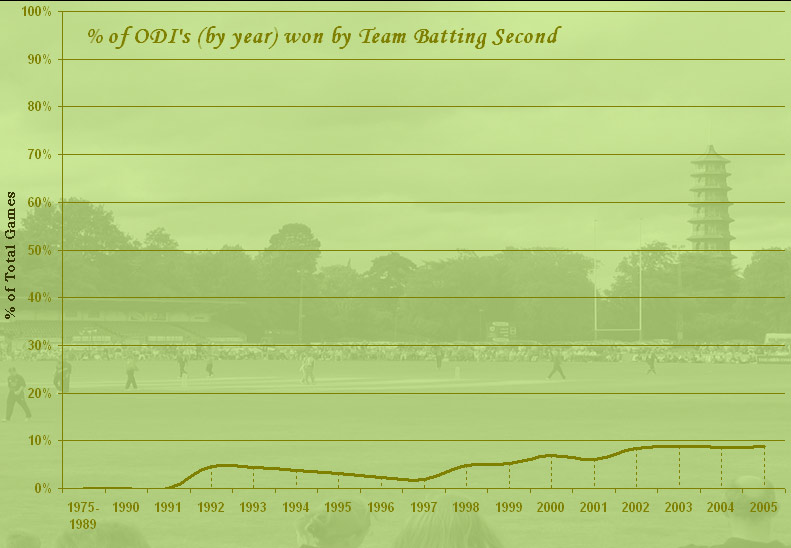
(this is a cumulative % and excludes games won on D/L method).
Also, not only do teams batting first (scoring 300 or more) win over 90% of the games, the average margin of victory stands at a staggering 101 runs!
I agree that when teams batting second do win or get close to the target (like the two games between NZ & Aus in December) the games tend to be great, but these games are few and far in between a load of one-sided encounters.
So at half time the 9/1 odds may look favourable, but don't be fooled and bet on the team batting second (not yet anyway).
Sadly, the only people who think that more is not less are the adminstrators who run this game. Bring on more Powerplays, I say, and see the % of 300+ scores shoot through the roof but don't put your money on an exciting game.
Anyway (on a slightly different note), its not all doom and gloom out there, as this suggests.

The number of ODIs being played over the years seems to be finally heading south and I hope its not just a blip...
postscript: Just watching the current Twenty20 game between
Saturday, January 07, 2006
No Black on White, no stats, but some story that...
And with a heavy heart, but on public demand, I have the changed the colours on this blog. On hindsight, I do a agree with this neutral colour theme.
Anyway, while I run around trying to find some more interesting stats, here is something for the weekend; my not so serious attempt at writing.
Hope you like it.
Anyway, while I run around trying to find some more interesting stats, here is something for the weekend; my not so serious attempt at writing.
Hope you like it.
Friday, January 06, 2006
Twenty20
I belong to the (old) school of thought that says if you want to win a Test match, you first pick up a bowling attack that can get you twenty wickets before picking up the batsmen who can score 500 runs.
So, IMO, a better bowling attack is the one that has a "better" potential to take twenty wickets in a Test.
I made this point during the recent Ashes and showed how England had an edge over Australia in the bowling department and hence were better placed to take wickets. And in hindsight, it wasn't such a bad analysis :-)
Now, our very own "Bhai bhai Ashes" is being billed as the contest between the Pakistani bowlers and the Indian batsmen, thus giving the impression that the Pakistan has a "better" bowling attack than India.
Question is; is it? Lets see...
To determine which is the better, I have analysed both bowling attacks based on their "Wicket Taking Potential" (WTP, to coin my own abbreviation), which is the simple addition of the Wickets per match statistic of their front line bowlers.
I have assumed that the bowling attack for India will consist of Pathan, Kumble, Harbhajan and Zaheer (sorry Agarkar) and Pakistan will go with Akhtar, Sami, Naved and Kaneria.
Also, to get a better spread for analysis, I have determined the WTP based on the records from the last 5, 10, 15, 20 Tests and entire career. (Except in the case of Naved, who has only played in 7 Tests and Pathan, in 18).
Here it is...

As you can see, the Indians, on any given 5 days, can take about 3 more wickets that the Pakistanis thus making them a "better" attack.
Have I missed something here? Ah, yes! While I can chose to ignore part time bowlers like Malik, Shewag, Tendulkar and Yuvraj (ok Ganguly as well), Afridi is too good a bowler to ignore, as India found out at Bangalore last year.
So what does his inclusion do to the Pakistani WTP? This...

Though India still have their noses ahead, the difference becomes negligible. However, the balance now tilts in favour of Pakistan because (again old school thought) a five man bowling attack is better than four.
Now, this WTP analysis ignores an important aspect that also determines the quality of a bowling attack. It is the bowling average (number of runs given per wicket). Needless to say, if both bowling attacks have the same WTP, the one which gives away less runs wins.
I have used the bowling averages to determine the potential runs a bowling attack is likely to give away while taking 20 wickets, i.e. I have multiplied the bowling average with wickets per Test for each bowler, added it for the entire attack and normalised it to twenty wickets (for example, if India gives 340 runs to get 17 wickets, they will give 400 runs to get 20).
So how do both the bowling attacks compare in this department?

So no matter what the pundits say, reverse swing or not, I think the Indian bowling attack is miles ahead of Pakistan.
Having said that, when Akhtar steams in to bowl to Sehwag, all this counts for nothing...
postscript: Sometimes you don't need 20 wickets to win as the Aussies demonstrated today. In fact, this is the 11th time that a team has declared in the 3rd innings of a Test and lost. And the third time when a team has declared both its innings and lost (including the famous famous Cronje game at the centurion when South Africa scored 248/8 and then forfeited one innings along with England, and England scored 251 for 8 to win).
So, IMO, a better bowling attack is the one that has a "better" potential to take twenty wickets in a Test.
I made this point during the recent Ashes and showed how England had an edge over Australia in the bowling department and hence were better placed to take wickets. And in hindsight, it wasn't such a bad analysis :-)
Now, our very own "Bhai bhai Ashes" is being billed as the contest between the Pakistani bowlers and the Indian batsmen, thus giving the impression that the Pakistan has a "better" bowling attack than India.
Question is; is it? Lets see...
To determine which is the better, I have analysed both bowling attacks based on their "Wicket Taking Potential" (WTP, to coin my own abbreviation), which is the simple addition of the Wickets per match statistic of their front line bowlers.
I have assumed that the bowling attack for India will consist of Pathan, Kumble, Harbhajan and Zaheer (sorry Agarkar) and Pakistan will go with Akhtar, Sami, Naved and Kaneria.
Also, to get a better spread for analysis, I have determined the WTP based on the records from the last 5, 10, 15, 20 Tests and entire career. (Except in the case of Naved, who has only played in 7 Tests and Pathan, in 18).
Here it is...
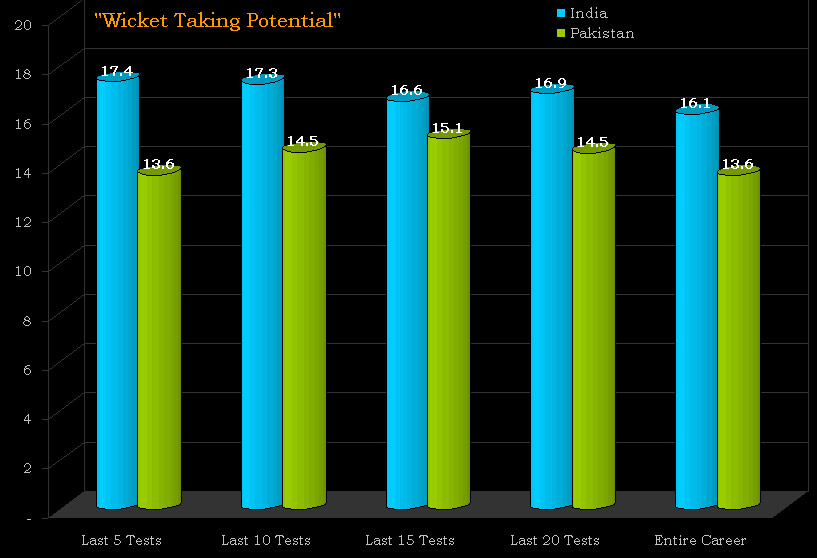
As you can see, the Indians, on any given 5 days, can take about 3 more wickets that the Pakistanis thus making them a "better" attack.
Have I missed something here? Ah, yes! While I can chose to ignore part time bowlers like Malik, Shewag, Tendulkar and Yuvraj (ok Ganguly as well), Afridi is too good a bowler to ignore, as India found out at Bangalore last year.
So what does his inclusion do to the Pakistani WTP? This...
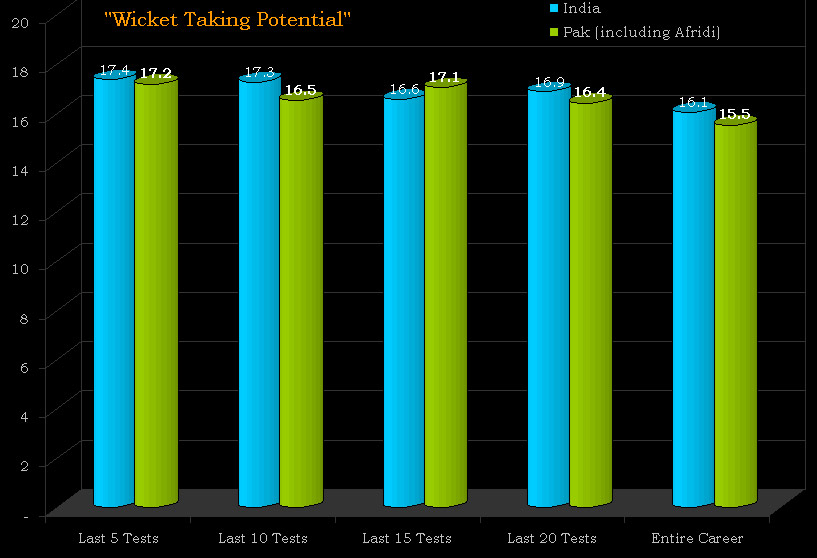
Though India still have their noses ahead, the difference becomes negligible. However, the balance now tilts in favour of Pakistan because (again old school thought) a five man bowling attack is better than four.
Now, this WTP analysis ignores an important aspect that also determines the quality of a bowling attack. It is the bowling average (number of runs given per wicket). Needless to say, if both bowling attacks have the same WTP, the one which gives away less runs wins.
I have used the bowling averages to determine the potential runs a bowling attack is likely to give away while taking 20 wickets, i.e. I have multiplied the bowling average with wickets per Test for each bowler, added it for the entire attack and normalised it to twenty wickets (for example, if India gives 340 runs to get 17 wickets, they will give 400 runs to get 20).
So how do both the bowling attacks compare in this department?
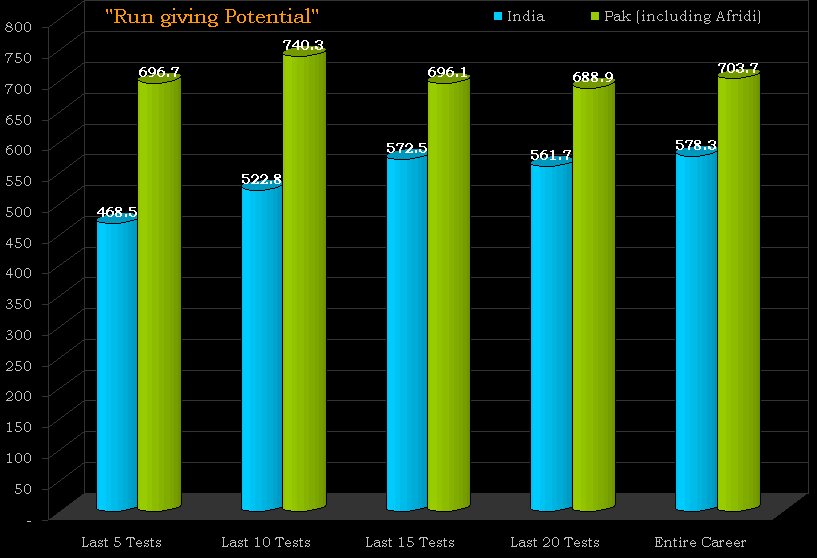
So no matter what the pundits say, reverse swing or not, I think the Indian bowling attack is miles ahead of Pakistan.
Having said that, when Akhtar steams in to bowl to Sehwag, all this counts for nothing...
postscript: Sometimes you don't need 20 wickets to win as the Aussies demonstrated today. In fact, this is the 11th time that a team has declared in the 3rd innings of a Test and lost. And the third time when a team has declared both its innings and lost (including the famous famous Cronje game at the centurion when South Africa scored 248/8 and then forfeited one innings along with England, and England scored 251 for 8 to win).
Wednesday, January 04, 2006
Serious Cricket Anyone?
I take it that the BCCI have finally got fed up with the amount of games it is forced play against the likes of Zimbabwe and Bangladesh and are ready to challenge the ICC'’s 10-year Test schedule. The reason? They want to start playing serious cricket. Secretly, all the other major Cricketing nations are nodding their heads in agreement and are backing the BCCI. After all, thatÂ’s what their fans, players and sponsors want to see, don'’t they?
As fans, we should all rejoice that the BCCI is ready to take a sensible stand, on behalf of us and the rest of the cricketing world. However, before we decide to open the champagne and celebrate, it will be interesting to look back and see how much meaningless cricket (against the minnows) the ICC has '“forced'” down our throats in the last six years.
I have done a brief analysis of all ODIs and Tests played by each country since Jan 2000. (click on all images to get the bigger picture).
First, the number of ODIs played by country

As you can see, India leads the pack, closely followed by Pakistan, England and the West Indies.
And now the Tests played, again by country…
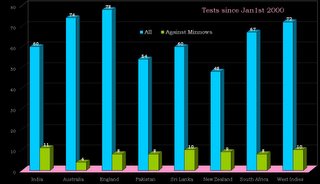
Again, India leads the pack, which is even more surprising considering the amount of Test cricket we play.
Now combining the figures, we get the average days of cricket played per year (assuming 5 days of Test cricket, which is a bit rare against Minnows, but never mind).

Again no surprises there.
While you look at this chart, ask yourself this question; if the sub continent is indeed the centre of the cricketing World, why do India, Sri Lanka and Pakistan play less cricket than say West Indies, where the game is all but dead! Don'’t expect an answer anytime soon.
Ok before I proceed, apologies if I made you believe that India consistently plays 80 days of cricket every year. Just to clarify, this is the actual number of days of cricket being played (by country) every year since 2000, and as always, India continues to dominate both, the low and high ends of graph.
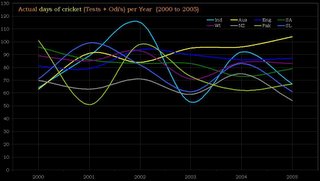
Pakistan probably has a genuine reason for an inconsistent schedule (due to security concerns after 9/11, etc) but how the BCCI managed to schedule 115 days of cricket in one year, and 53 the very next is beyond me! But I had made this point in one of my earlier posts, so I will pass.
Some of you may look at these numbers and say, yes India is on top because we play more cricket but overall as a percentage, we cant be that bad, can we?
Here is the answer.

And hence they are upset, and may I remind you, with the ICC.
Now if only the BCCI had bothered to find out how the other countries manage to play more cricket (and that to consistently) and less of the meaningless cricket in question, and yet adhere to the ICC'’s policy (however stupid it may be)?
But I guess it'’s a lot easier to pick up the phone and make a call across the Arabian Sea and shout foul.
Anyway, I do hope the BCCI knows what to do with the spare time once they decide not to play Zimbabwe and Bangladesh. After all, the next team to visit India after England (in Mar 2006) is Zimbabwe in October 2007, followed by West Indies in 2008!!! (Talk about Home advantage for the next two years)
So if India decides not to play Zimbabwe at the end of next year, we may not have any team visiting India for the next two years, unless we can convince someone to come down and fill in he gap. But last I checked, not many countries seem to have the spare time in their busy schedules. Well, there is always Bangladesh from across the border, but…
I guess the BCCI really donÂ’t care about this 2 year gap. They just want to play cricket (as long as it is meaningful) and if they can make the money via TV rights, what is the need to host cricket in India as all. With 70% of the tickets given away as passes, the real fans donÂ’t get to see the games anyway, so why bother with the logistics of hosting games for a few thousand rupees in gate receipts.
Anyway, in case you want to mark your calendars in advance (so as to stay away from your Television sets), according to the ICC schedule, India have to visit Bangladesh, host Zimbabwe and visit Zimbabwe in the next 5 years. A WHOLE 30 days of pointless Test cricket!!! As opposed to the 65 days of Test cricket that was forced upon us in the last 6 years.
Damn, I deviated in this post, as my point really was about the ICC and the crap it forces down the throats of the like of the BCCI, and not about the BCCI itself.
Never mind…
As fans, we should all rejoice that the BCCI is ready to take a sensible stand, on behalf of us and the rest of the cricketing world. However, before we decide to open the champagne and celebrate, it will be interesting to look back and see how much meaningless cricket (against the minnows) the ICC has '“forced'” down our throats in the last six years.
I have done a brief analysis of all ODIs and Tests played by each country since Jan 2000. (click on all images to get the bigger picture).
First, the number of ODIs played by country
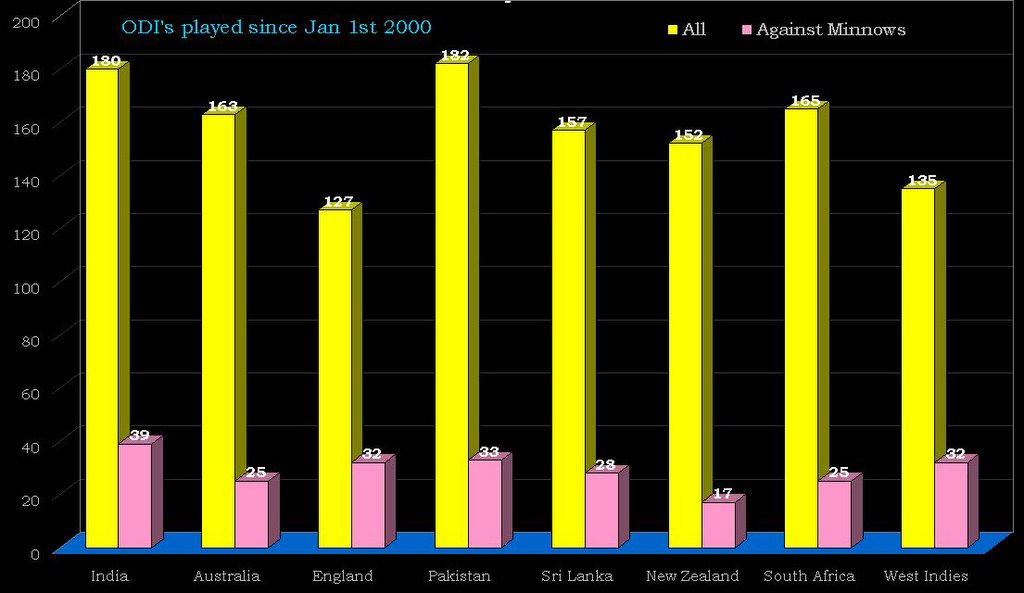
As you can see, India leads the pack, closely followed by Pakistan, England and the West Indies.
And now the Tests played, again by country…
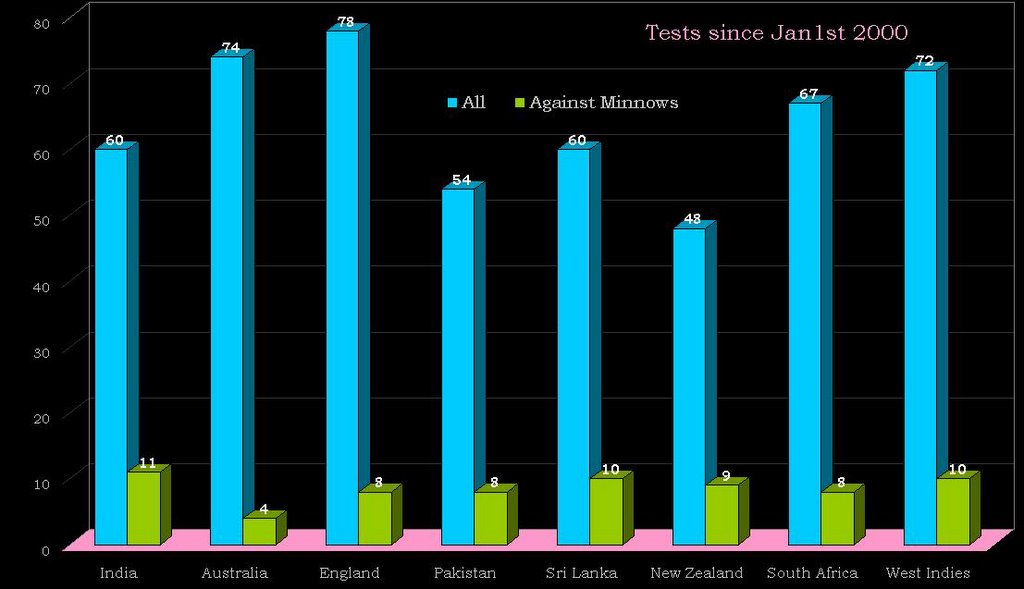
Again, India leads the pack, which is even more surprising considering the amount of Test cricket we play.
Now combining the figures, we get the average days of cricket played per year (assuming 5 days of Test cricket, which is a bit rare against Minnows, but never mind).

Again no surprises there.
While you look at this chart, ask yourself this question; if the sub continent is indeed the centre of the cricketing World, why do India, Sri Lanka and Pakistan play less cricket than say West Indies, where the game is all but dead! Don'’t expect an answer anytime soon.
Ok before I proceed, apologies if I made you believe that India consistently plays 80 days of cricket every year. Just to clarify, this is the actual number of days of cricket being played (by country) every year since 2000, and as always, India continues to dominate both, the low and high ends of graph.
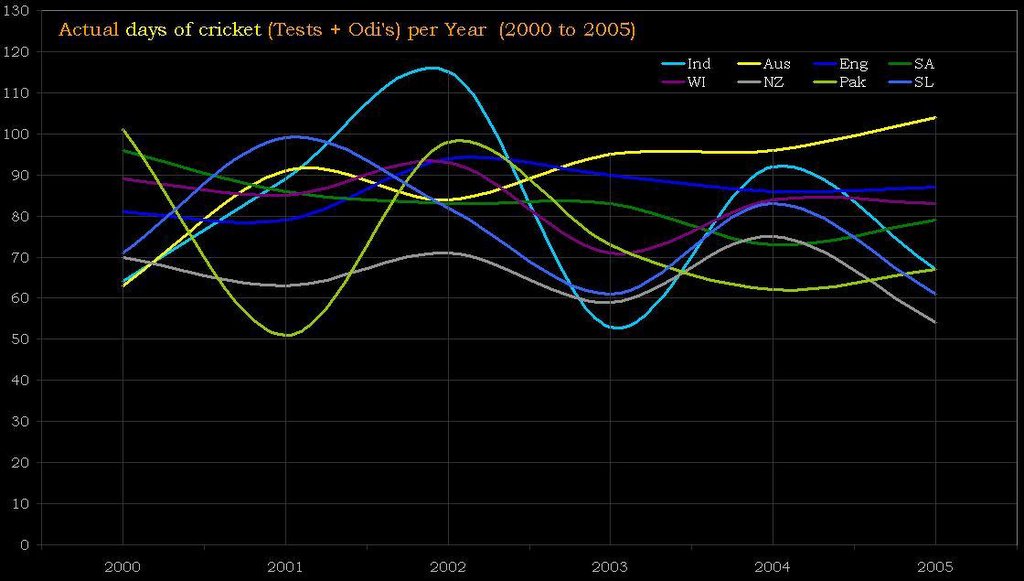
Pakistan probably has a genuine reason for an inconsistent schedule (due to security concerns after 9/11, etc) but how the BCCI managed to schedule 115 days of cricket in one year, and 53 the very next is beyond me! But I had made this point in one of my earlier posts, so I will pass.
Some of you may look at these numbers and say, yes India is on top because we play more cricket but overall as a percentage, we cant be that bad, can we?
Here is the answer.

And hence they are upset, and may I remind you, with the ICC.
Now if only the BCCI had bothered to find out how the other countries manage to play more cricket (and that to consistently) and less of the meaningless cricket in question, and yet adhere to the ICC'’s policy (however stupid it may be)?
But I guess it'’s a lot easier to pick up the phone and make a call across the Arabian Sea and shout foul.
Anyway, I do hope the BCCI knows what to do with the spare time once they decide not to play Zimbabwe and Bangladesh. After all, the next team to visit India after England (in Mar 2006) is Zimbabwe in October 2007, followed by West Indies in 2008!!! (Talk about Home advantage for the next two years)
So if India decides not to play Zimbabwe at the end of next year, we may not have any team visiting India for the next two years, unless we can convince someone to come down and fill in he gap. But last I checked, not many countries seem to have the spare time in their busy schedules. Well, there is always Bangladesh from across the border, but…
I guess the BCCI really donÂ’t care about this 2 year gap. They just want to play cricket (as long as it is meaningful) and if they can make the money via TV rights, what is the need to host cricket in India as all. With 70% of the tickets given away as passes, the real fans donÂ’t get to see the games anyway, so why bother with the logistics of hosting games for a few thousand rupees in gate receipts.
Anyway, in case you want to mark your calendars in advance (so as to stay away from your Television sets), according to the ICC schedule, India have to visit Bangladesh, host Zimbabwe and visit Zimbabwe in the next 5 years. A WHOLE 30 days of pointless Test cricket!!! As opposed to the 65 days of Test cricket that was forced upon us in the last 6 years.
Damn, I deviated in this post, as my point really was about the ICC and the crap it forces down the throats of the like of the BCCI, and not about the BCCI itself.
Never mind…
Sunday, January 01, 2006
Catch me if you can...
For a few years now, the rest of the cricketing world has been trying to catch-up with the Aussies. One of the (many) areas the Aussies have been ahead of the others is in scoring hugh first innings totals and that to an an alarming run-rate.
So, how do the other countries compare with the Aussies, and is the gap finally closing?
Here is the comparision of Run rates and Average runs per wicket (by year) between the Aussies and their opposition (in head to head games).

I know there is the Ashes factor in 2005 but can we hope to see the gap closing further in 2006?
Another vital stat to look out for this year...
The Punter and the Wall
They both started their careers within 6 months of each other and in similar fashion with scores of 95 & 96 respectively.
When they first came face to face, they had scored 193 & 187 runs respectively (with 2 fifties each).
When they last met (in the ICC-XI Vs Aus "TEST" in 2005), they had both added over 7,000 runs to their names and were playing their 92nd and 94nd Test Respectively. And at the end of last year only 13 runs and 0.90 points in their average seperated the two.
And yes, both bat at Nr. 3, have 58 & 59 Fifty-plus scores in Test cricket, and also captain their respective sides.
Have their been any other players in Test Cricket whose careers have been so closely linked? Lara and Sachin come to mind...
Anyway, will be fun to see who gets to 10,000 first. I am tempted to put my money on Punter, now that he is finally ready to go over the wall, but I wouldn't like to bet against the Wall either...

Saturday, December 31, 2005
The Making of Freddie
It took seven years for him to fulfill his potential, but most (including the Aussies) will agree it was well worth the wait.
From being the Next Botham in 1998, to the Fat Lad in 2000 and finally World Beater in 2005, this is his journey over the years.

ps. The Red line indicates the point when his batting average finally overtook his bowling average (the hallmark of a Genuine allrounder).
From being the Next Botham in 1998, to the Fat Lad in 2000 and finally World Beater in 2005, this is his journey over the years.
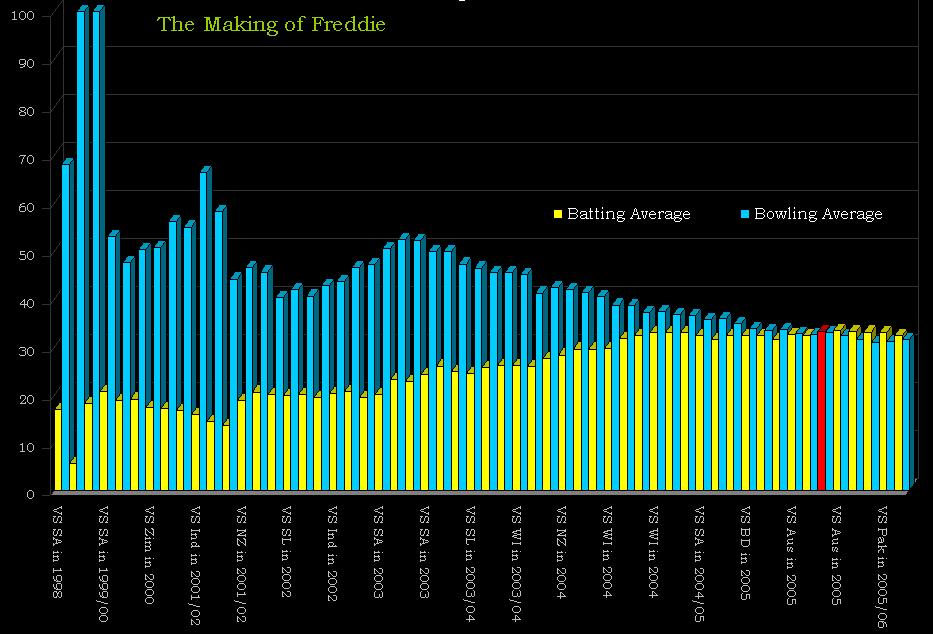
ps. The Red line indicates the point when his batting average finally overtook his bowling average (the hallmark of a Genuine allrounder).
Friday, December 30, 2005
35 years, 323 days and counting (down)...
There is nothing sadder then watching a great player struggle at the end of his career, and they don't come any greater than the Pigeon himself.
Six months ago, McGrath was Australia's undisputed strike bowler (of course along with Warne) but since coming back from his freak injury after Lord's 2005, his Strike Rate and Bowling Average has been on a decline.
Though he did finish the Melbourne Test with 4 wickets, he has taken just 31 wickets in the last 9 Tests (excluding Lord's) at SR of 62.13 and Average of 28.52 (compared to a career SR of 51.3 and Average of 21.44). But more importantly, he rarely looks like taking wickets these days. His is not accurate (one of his biggest strengths) and he is (now) just a line and length bowler who can be taken apart.
Question is, will he realize his time is up, or will he prove me wrong with another "5 for nothing" performance at Sydney next week? Either way, I will be surprised if he is still around for the Ashes next year, let alone the World Cup 2007.
Anyway, here is his Cumulative Strike Rate and Bowling Average since Lord's 2005 (included)...

(click on image to view)
Six months ago, McGrath was Australia's undisputed strike bowler (of course along with Warne) but since coming back from his freak injury after Lord's 2005, his Strike Rate and Bowling Average has been on a decline.
Though he did finish the Melbourne Test with 4 wickets, he has taken just 31 wickets in the last 9 Tests (excluding Lord's) at SR of 62.13 and Average of 28.52 (compared to a career SR of 51.3 and Average of 21.44). But more importantly, he rarely looks like taking wickets these days. His is not accurate (one of his biggest strengths) and he is (now) just a line and length bowler who can be taken apart.
Question is, will he realize his time is up, or will he prove me wrong with another "5 for nothing" performance at Sydney next week? Either way, I will be surprised if he is still around for the Ashes next year, let alone the World Cup 2007.
Anyway, here is his Cumulative Strike Rate and Bowling Average since Lord's 2005 (included)...
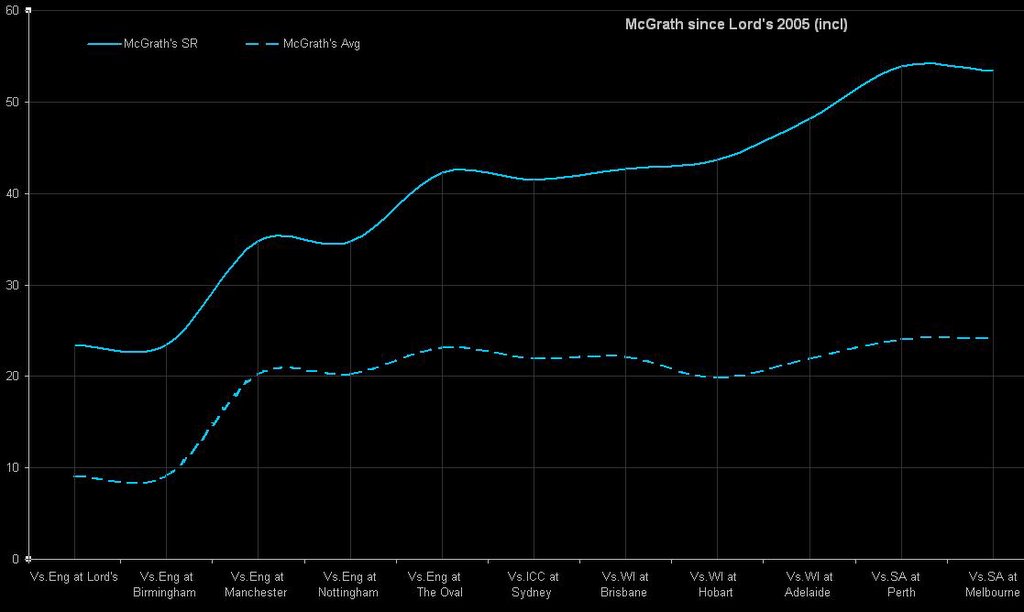
(click on image to view)
Thursday, December 29, 2005
SRT Vs SG (again)
I know its a few days old, but I came across this article by Ashok Mitra in the Telegraph, so couldn't resist.

(click on image to view)
Now if only someone could point Mr Mitra to this blog so he can shut up, once and for all. In case he still misses the point (or the lines), SG's Average since the World cup excluding the Minnows is 27.08 (as opposed to SRT 42.31). Or in other words he has scored 1083 runs in 40 completed innings compared to Sachins 1,777 in 42 (again excluding the minnows). And no, his stats including the minnows dont get any better either....
Walk (but don't hop) like an Aussie!
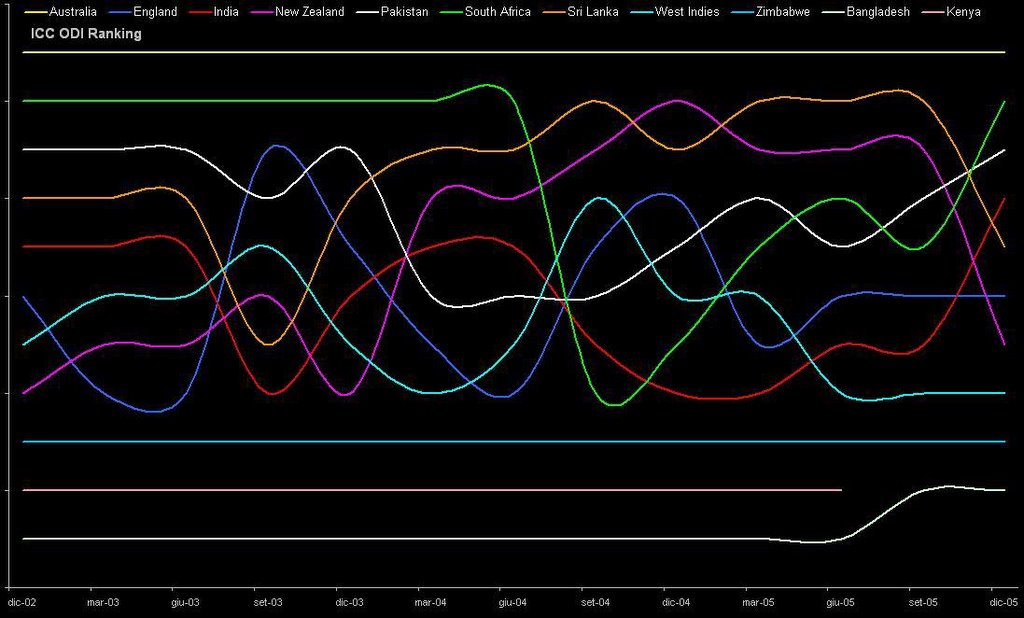
More Spaghetti here, but this time of the shorter version.

(click to view larger image)
Nothing special if you look at this in isolation. However, if you merge India’s ranking in the ODI’s with that of its Test Ranking during the corresponding period, you get an interesting picture.

(click to view larger image)
Is it pure coincidence that India's ODI and Test Performances have finally began to move upwards, and more importantly, merge since Greg Chappell took over?
ps. Apologies, my laptop is still acting up. and I am working on an Italian computer, hence the Months are in Italian. But you get the point. I hope...
(click to view larger image)
Nothing special if you look at this in isolation. However, if you merge India’s ranking in the ODI’s with that of its Test Ranking during the corresponding period, you get an interesting picture.

(click to view larger image)
Is it pure coincidence that India's ODI and Test Performances have finally began to move upwards, and more importantly, merge since Greg Chappell took over?
ps. Apologies, my laptop is still acting up. and I am working on an Italian computer, hence the Months are in Italian. But you get the point. I hope...
Wednesday, December 28, 2005
Break-down
Guys,
Sorry for ignoring the blog these last few days. I am on Skiing holiday in the Italian Alps but worse, my Laptop's gone kaput. While the former was a welcome and planned break, the latter definitely wasn't.
And while I am busy trying to sort out my Skiing and the Laptop (both of which can be, on a cold icy day, a real pain in the backside), here is wishing you all a (Belated) Merry Christmas and a Happy New Year...
Thursday, December 22, 2005
One more to go...
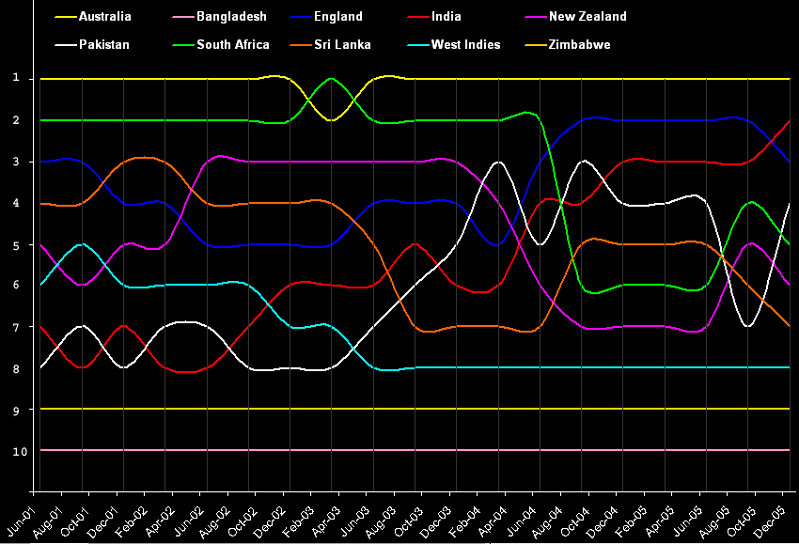
So India has finally reached the Nr. 2 spot in the ICC Test Championship (which indecently is the only Sporting Championship in the world without a Winner).
While we all know that India is some way away from reaching the top, lets not forget that India’s progress in the last four years (in Test cricket) has been remarkable.
Here is the journey of the various Teams since the ICC Test Championship was introduced in 2001. Looks like Spaghetti to me, but that could be because I spend too much time in Italy....
(Click on the image to view)
Subscribe to:
Posts (Atom)